
Workshop Manifesto Windows
The Art of Publicizing New Stained Glass Companies in Toronto in 1892 and 1907

Toronto’s inventory of Victorian stained-glass house windows was designed by just a few people. Although forgotten later, their names and styles would have been well known among the building trade at the time.
These artists sold to developers, not to any artistic market, and they only ever met their end users—the home buyers—by accident. Their art was intended to be what we now call ambient, a presence that can be ignored but that gives satisfaction when you do focus on it. This ambient quality required their art to be blank in terms of meaning. The art was not meant to say anything of substance to the general public. It was specifically required not to.
But many of the windows were filled with specific meanings, because the participants in this business used the windows to speak to one another. Sometimes members of the studio would share jokes in the windows, but the most urgent messages were the ones that told the developers where to shop.
William Potts and his protege John Hurst initiated the domestic trade for the Dominion Stained Glass Company starting in 1886. In 1890 they were joined by Joseph Schneider, the second protege. These three artists define the core tradition of Toronto domestic glass. In broad terms, Potts conceived the whole business, Schneider refined it, and Hurst made sure it got done. In 1891, these three were filling the downtown core with windows, more than fulfilling the expectations of their friends and employers, John Harrison and William Wakefield. Dominion, born as a luckless operation in 1886, had come back strong as a completely novel company, largely bypassing the church market to play a totally different game. In 1891, Dominion was a hit.
William Wakefield had a heart attack and died suddenly in 1891. Although I know no details, whatever happened next broke up the company. The three designers left and founded their own company, the Victoria Stained Glass Company. The surviving partner, John Harrison, joined them as Manager, but they put up whatever money was involved. Victoria appears in the City Directory in 1892.
Looking at the overall collection of windows, this break might be easy to miss, because the trail of art is continuous. The art changes company without changing much in nature. If Dominion was making house windows in 1892, they were using old designs. It seems likely that two workshops were making John Hurst-style studio windows in 1892, Dominion and Victoria (with Hurst himself at Victoria).
For all three artists, 1893 was a glorious year. In 1893, they had artistic freedom. In truth, they had been pretty free before, but they seemed to feel it more at Victoria, producing works that explored their differences and emphasized their personal aesthetics to an extent rarely indulged at Dominion.
When they changed company, who did they tell, and how?
The first of the Manifesto Windows to come to my attention was the bizarre front fanlight of 22 Madison.
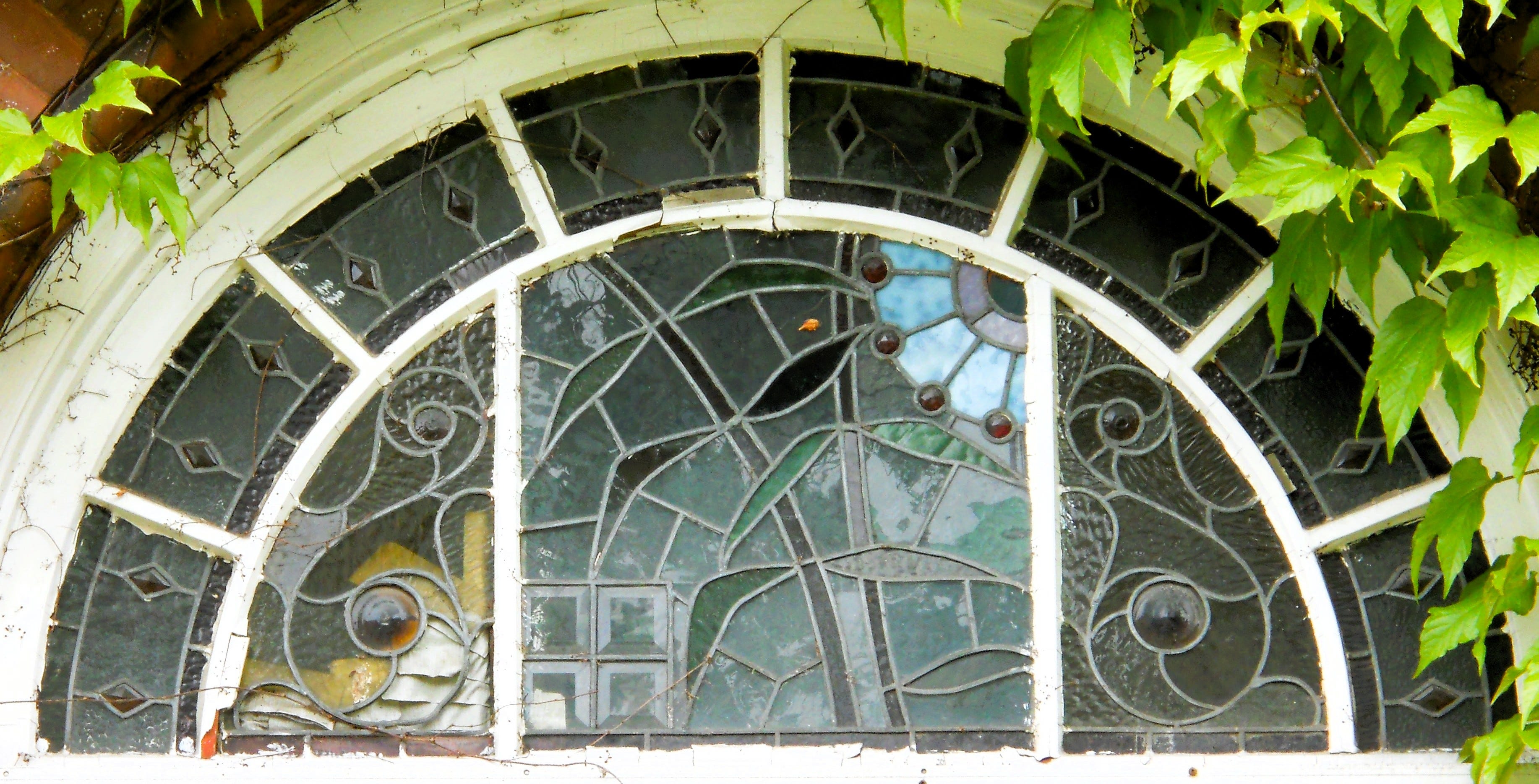
Although I grew up only a few blocks from this window, I didn’t really notice it until 1987, when I lived up by Dupont and took Madison a lot. This was one of the windows that convinced me I had a problem. As in, this window requires an explanation. It makes so little sense as a thing, and is so unlike pretty much all other things, as to require an explanation from time. It meant that the windows were a worthy problem to work.
The main feature was a stand of… bamboo? Above that there was a sort of sunburst, but in blue. In the lower corner, there were four square bevels. To the extent that the middle of the object was a picture, these played no role in it.
The window, border aside, was in three sections, which was normal enough. The outer sections—the wings—were spiral arabesques, which was also normal.
The border was separated into panels by woodwork, which was very unusual but not unique. The panels themselves, all the same, had big rhomboidal crystals, two each, separated by a pane of glass with two sharp concave cuts, which is either a nightmare or means someone is showing off.
What could it be? It took me 38 years to figure it out. I went on, did life, almost forgot about it. But then I got called in as an expert for advice on how to fix this:
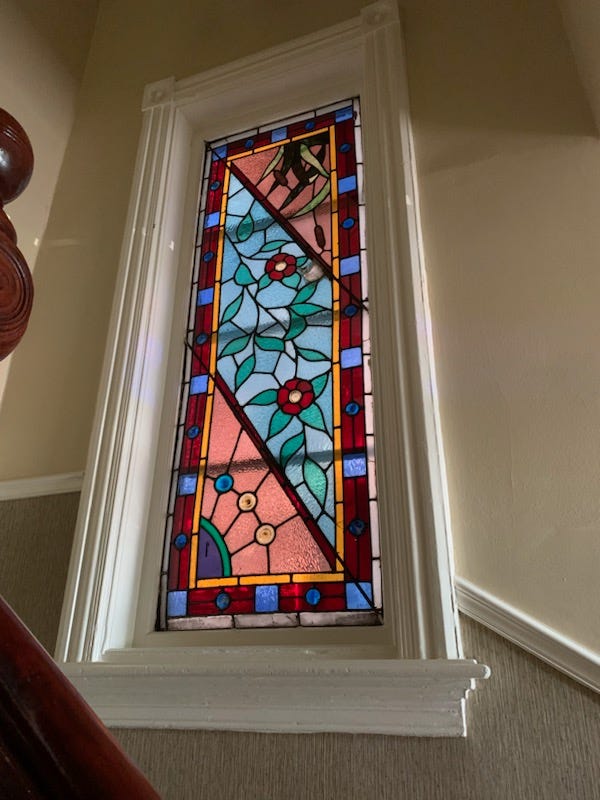
The similarities to 22 Madison were obvious. Both have massive segmented borders with gems. Both have a sunburst and a plant, in this case a bulrush. Instead of arabesques, this one has a really lovely panel of rose foliage in a textile-derived style. This one lacks bevels. Unhelpfully, this one is and always has been upside-down.
By 2024, when I saw the second one, I was beginning to understand. I suspected that the odd sunburst motif was a signature from one artist. The plant, not a common motif in Toronto, seemed to be another signature. Were they all signatures?
They were both installed in 1892, the year the three artists founded Victoria.
These windows, the semicircles (there are two) and the stair panel, were designed in 1892 to advertise the brand-new Victoria Stained Glass Company. The target audience was the builders. The message was: here we are. Potts (the sunburst), Schneider (the arabesques/roses), Hurst (the big reckless border), and Conacher (the new guy, the plant). By putting these windows up in public, they informed their long-standing patrons—a few dozen people—that Dominion was no longer the place to go.
Once they had done this, and the word was out, the windows were not longer needed. The two semicircles ended up in a prominent location on Madison, which was being built right then by all the right builders. It is possible that 22 Madison was always the intended destination of those windows—that the artists commandeered that commission to put up their sign.
The stair window, whose location I have agreed not to reveal at present, ended up in a much more arbitrary place, invisible from the street. In this case, I think a showroom customer just bought it and they let it go.
These workshop manifesto windows were meant to be read as signs, not pictures. Even Conacher’s plants, the most representational elements in the whole lineage, are used as signs. These windows partake of a different branch of abstraction than the others do. For their contemporaries who were not developers, they were so abstract as to be illegible, such that one of them ended up upside-down and nobody noticed until I did 134 years later.
I find it interesting that these windows do not promise a style as such, just the participation of these artists. As statements of style, they could hardly be more senseless.
The stair window, seen in life, is ravishingly beautiful, with a calm but lively surface all rendered in muffle-textured glass. This preference for muffle comes from Joseph Schneider and was a great contribution of his to Victoria. I think Schneider started by seeing his windows as mosaics but then evolved to see them as fabrics, which then led him to give the whole surface a common weave or pile.
Potts, his mentor, always saw his windows as fabrics, but as a different set. Potts borrowed is motifs from quilting, and his glass roof for Trinity Methodist (1889) looks like a blanket. Schneider, awoken to the metaphor, followed his aesthetic, towards a different game. In his foliage game, all the pieces are nearly the same size, and the contrast between foreground and background is minimized. The blue background, the green leaves, and the salmon backgrounds adjoining are all pastel colours of equal value. In a black-and-white image, they are hardly distinguishable. All of these choices are being made to support the idea of the surface as a cloth.
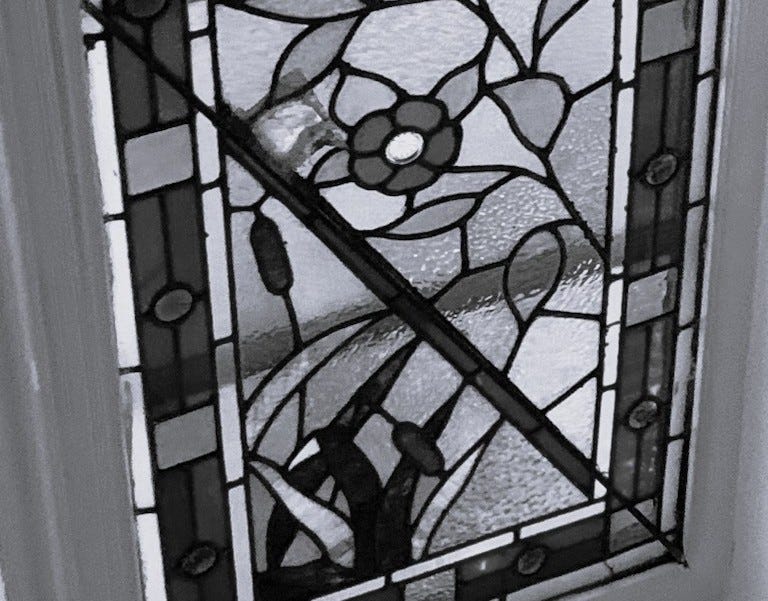
Schneider’s adoption of muffle glass as the universal standard instead of flat glass had the further advantage of making the windows more private. This showroom piece is showing off this feature too. When it was new in the window of their shop at 16 Sheppard, it would have been genuinely new. People would have gone, oh.
I have recently become aware that John Hurst was to do this again. Years later, in 1907, he co-founded the Standard Glass Company of Toronto. I believe that foundation was the occasion for two further manifesto windows.
By 1907, Potts was dead, and Schneider was a piano salesman. Dominion, controlled by Arthur Mackey, was producing unthoughtful copies of the old work. To John Hurst, it must have seemed time to remember the glory days of Victoria and go back to the old job.
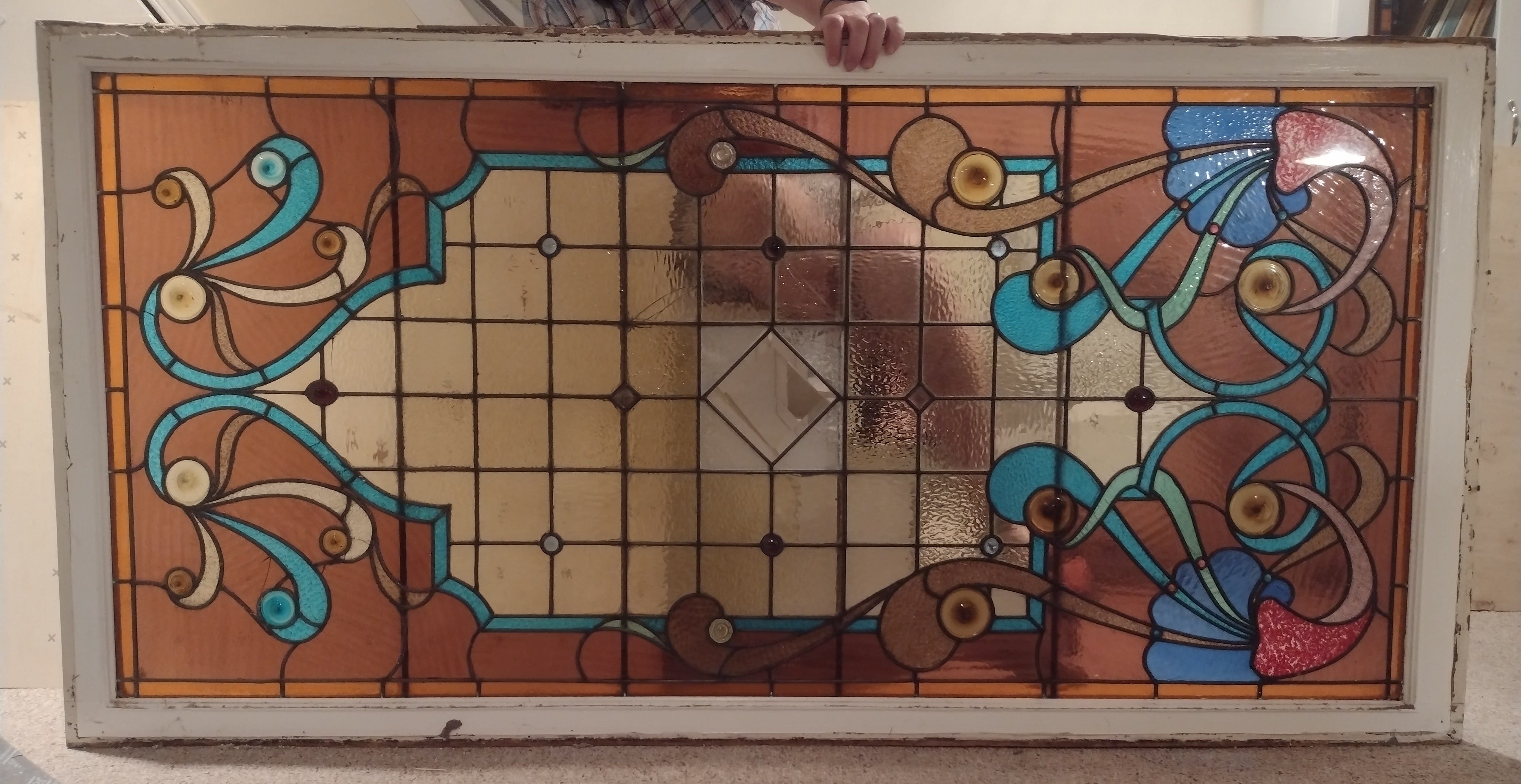
Showroom Manifesto Window for the Standard Glass Company, Joseph P. Schneider and John Hurst, 1907, Private Collection
This grand Italianate panel, a huge thing of the highest quality, proclaims the return of the old gang in their Victoria form. At the heart, a Potts grid is speckled with gens and Hurst’s signature flat bevels. A stylized bouquet of fronds, and the perfect balance of the composition, speak to the musical intelligence of Joseph Schneider. Only the glass itself, which is muffle but also lavish with new textures and colours, reminds us that we are in 1907, not 1893.
This one, its work done, got sold on to a renovated dining room on Berkeley. I wonder if the buyer got it cheap, because it was big and not bespoke, and Hurst had no further use for it.
Hurst’s manifesto’s, unlike the 1893 versions, are beautiful works of art with integrity as designs beyond their polemical purpose.
One more window counts, I suspect. 460 Palmerston’s 1907 Schneider fanlight is a very close match to his 1892 version for 39 Beaty.
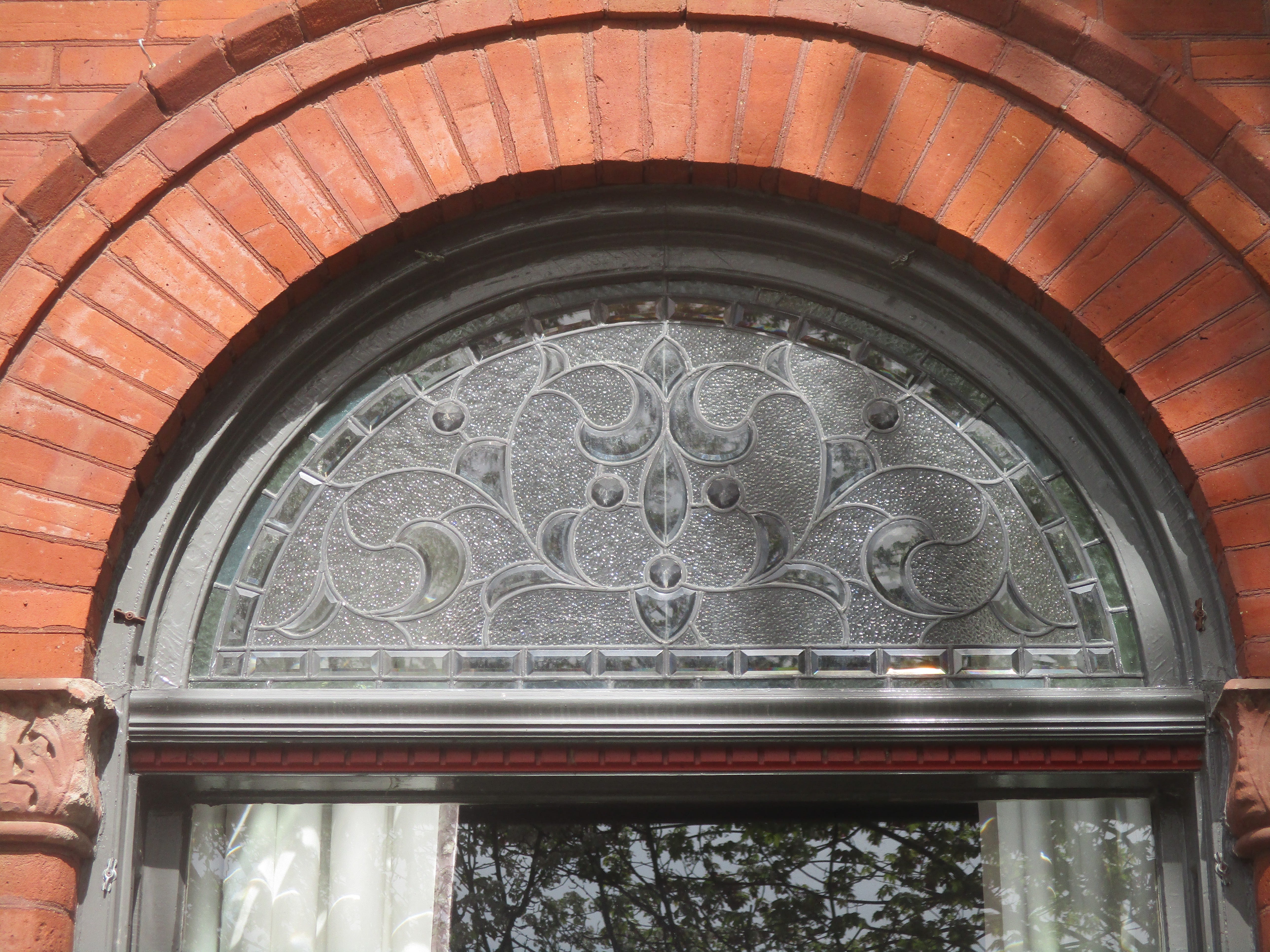
39 Beaty, Joseph P. Schneider and William F. Potts for Victoria, 1892
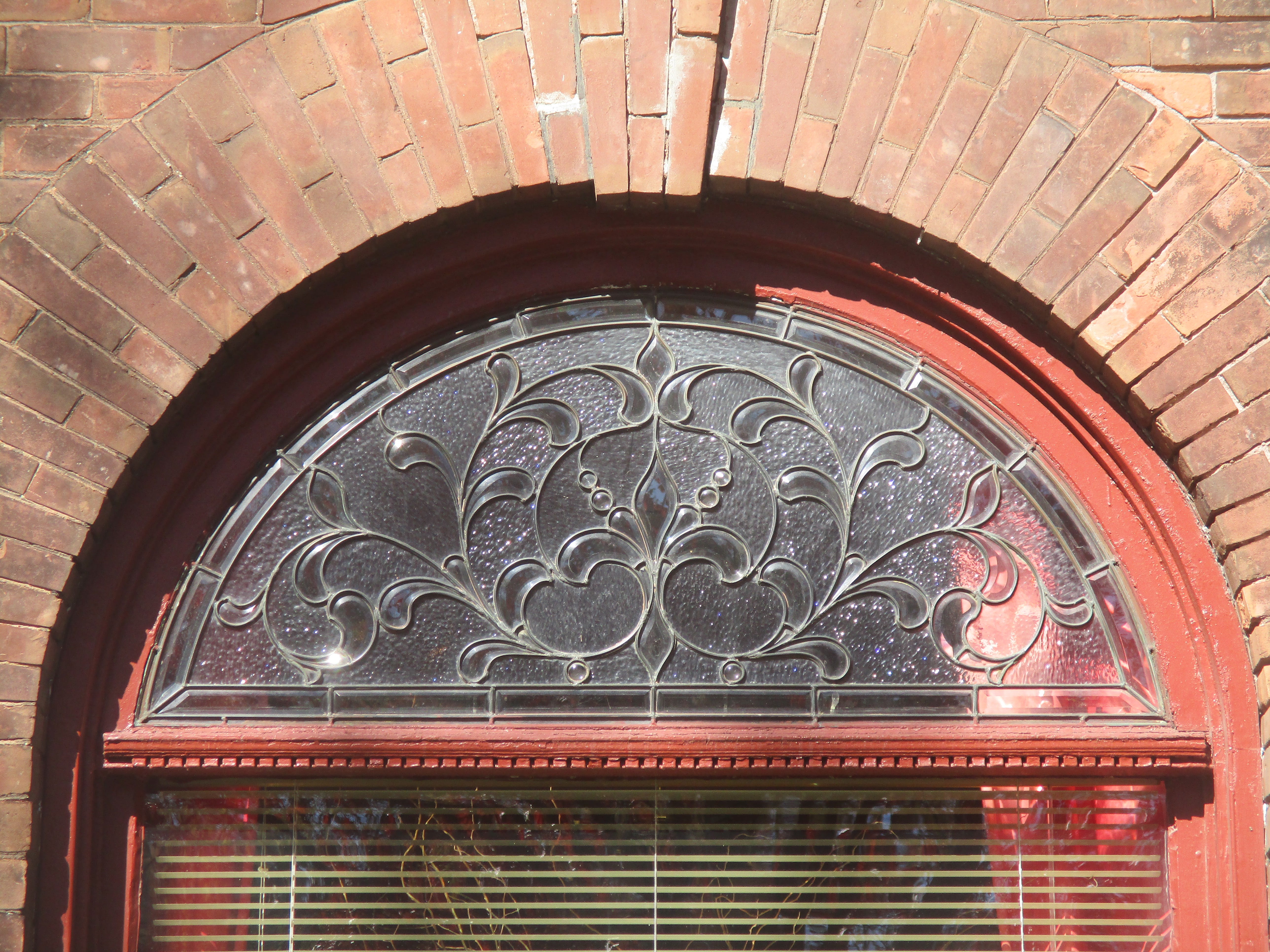
460 Palmerston, Joseph P. Schneider and John Hurst for Standard Glass, 1907
John Hurst has changed one feature, very touchingly. During their partnership, Hurst and Potts had a long dialogue about mitered corners, which Potts (rightly) thought made for fragile windows, and Hurst (always concerned with speed) tended to use anyway. At 39 Beaty, Potts used a square in the corner, as he preferred. At 460 Palmerston, with dear Potts dead, Hurst mitered the corner, deploying his signature but also re-opening a long, affectionate dialogue with his dead friend.
The builders who saw this window at 460 Palmerston might not have gotten the reference—although they might have. They would have known, immediately, that Joseph Schneider, the most serious actual artist among them, was working again, at the high end. They would also have been reminded that Arthur Mackey, who thought of himself as heir to Dominion and ran a company called Dominion, had nothing to do with the real Dominion lineage. With its grandeur, this window says what Hurst had good reason to feel: that Mackey was a cheap, derivative loser.
Like all the other companies before it, Standard Glass was to be short-lived. The balance between the ambitions of the artists and their stingy developer clients remained tricky to achieve.
Using the windows themselves as message boards for messages within the company and the industry was one of the characteristic foibles of the Dominion crew. This practice produced the least legible windows in the tradition in 1892, and then the most luxurious in 1907.
The workshop manifesto windows are of vital importance as documents of the stained glass industry in Toronto. Without them, the story could not have been deciphered.